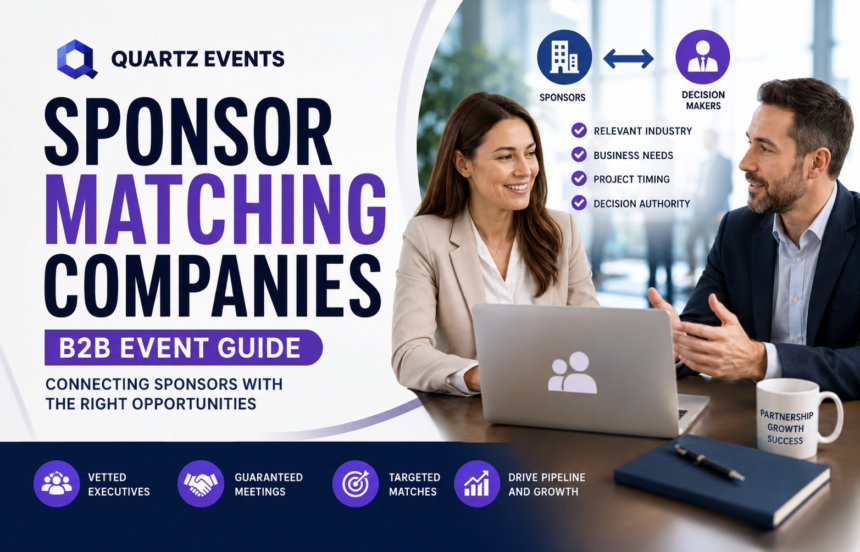
For B2B companies, sponsoring an event is no longer just about putting a logo in front of an audience. Businesses increasingly want direct conversations with decision-makers who have relevant challenges, active projects, and a genuine interest in potential solutions. This is where Quartz Events Sponsor Matching Companies and similar B2B matchmaking models can provide a more targeted approach.
Instead of depending entirely on booth traffic or casual networking, Quartz Network focuses on curated connections between sponsors and senior business professionals. The objective is simple: help companies spend less time searching for prospects and more time having useful conversations with the right people.
What Are Quartz Events Sponsor Matching Companies?
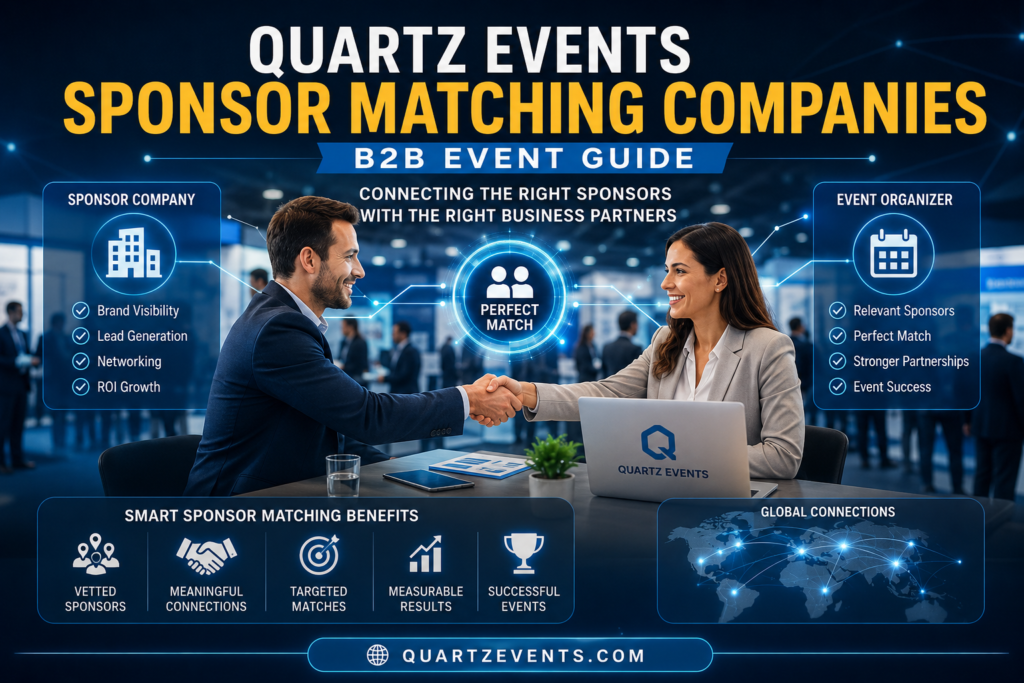
The term Quartz Events Sponsor Matching Companies generally refers to the sponsor-matching approach associated with Quartz Network. Rather than treating sponsorship as traditional event advertising, the model centers on connecting solution providers with relevant executive buyers through structured meetings and networking opportunities.
Quartz Network operates invitation-focused B2B leadership events covering areas such as technology, cybersecurity, finance, human resources, marketing, supply chain, procurement, and manufacturing. Sponsors can use these events to reach professionals whose roles and business priorities are relevant to their solutions.
The key difference is relevance. A traditional event may give a sponsor access to hundreds or thousands of attendees, but only a small percentage may actually be potential customers. A curated matchmaking model attempts to narrow that audience and create more meaningful business conversations.
How the Quartz Sponsor Matching Model Works
Sponsor matching works by collecting information from both sides of the event. Sponsors describe their ideal customer, while executive attendees provide information about their professional responsibilities, business priorities, challenges, and areas of interest.
The event organizer can then use this information to identify potential matches. The process is designed to make meetings more purposeful before the event begins rather than leaving every introduction to chance.
1. Sponsors Define Their Ideal Customer
The process starts with the sponsor. A company needs to explain who it wants to meet and what type of business problem its solution addresses.
For example, a cybersecurity provider may want conversations with CISOs or CIOs, while an HR technology company may prefer CHROs, HR directors, or talent leaders. Company size, industry, geography, job role, and business requirements can also influence the desired audience.
A clear ideal customer profile helps make the matching process more relevant.
2. Executive Buyers Are Qualified
The other side of the process is the executive audience. Quartz Network emphasizes senior-level professionals and invitation-based participation, helping create an audience that is more focused than a general public conference.
Attendees can share information about their current priorities, projects, technology requirements, or business challenges. This information gives sponsors more context than a basic attendee name and job title.
The result is a better starting point for a business conversation.
3. Relevant Meetings Are Arranged
After sponsor and attendee information is collected, potential matches can be identified based on business relevance.
Imagine a finance executive is evaluating new financial planning technology while a sponsor provides financial management software. A meeting between those two parties has a clear reason behind it.
This is different from walking around an exhibition hall hoping that the right person happens to stop at a booth. The meeting already has a defined business context.
4. Meetings Can Be Reviewed in Advance
A structured event model also allows participants to understand who they are meeting and why the conversation is relevant.
This preparation matters because executive meetings are more valuable when both participants understand the purpose. Sponsors can research the company, prepare relevant questions, and adjust their presentation instead of delivering the same generic sales pitch to everyone.
However, a qualified meeting should never be confused with a guaranteed sale. The meeting creates an opportunity; the sponsor still has to demonstrate value.
Why Businesses Are Moving Beyond Traditional Event Sponsorship
Traditional trade shows can be excellent for visibility, networking, product demonstrations, and brand awareness. However, they can also create a significant amount of unqualified traffic.
A booth may attract many visitors, but a visitor does not necessarily have purchasing authority or an active business need. Sales teams may spend hours collecting contacts that never become meaningful opportunities.
A sponsor-matching model takes a different approach by prioritizing targeted conversations.
For businesses selling enterprise software, consulting, cybersecurity, financial technology, HR solutions, or other high-value B2B services, the quality of a conversation can be more important than the total number of leads collected.
Benefits of Quartz Events Sponsor Matching
One of the biggest advantages is time efficiency. Instead of spending an entire event waiting for relevant prospects to approach a booth, sales representatives can work from a structured meeting schedule.
Another benefit is better preparation. When sponsors have information about the executives they expect to meet, they can research their organizations and prepare conversations around specific business challenges.
The model can also provide access to senior decision-makers. Reaching a C-level executive or department leader through ordinary outbound sales can take considerable time. A curated event can create an opportunity for that conversation in a much shorter period.
There is also a potential ROI advantage. Businesses can evaluate sponsorship based on qualified meetings, sales opportunities, pipeline progression, and revenue rather than simply counting booth visitors or badge scans.
Which Companies Benefit Most?
Quartz-style sponsor matching is generally most relevant to B2B companies with a clearly defined target audience.
Enterprise SaaS providers, cybersecurity companies, cloud technology firms, HR technology vendors, financial software businesses, marketing technology providers, consulting firms, supply chain platforms, and manufacturing technology companies can all benefit from direct access to relevant business leaders.
The model is particularly useful when a company’s products have a higher contract value or longer sales cycle. In these situations, one meaningful executive conversation can potentially be more valuable than dozens of low-quality leads.
Businesses selling inexpensive consumer products or seeking mass-market awareness may find traditional advertising, consumer events, or digital marketing more suitable.
Major Quartz Network Event Areas
Quartz Network organizes events around specific leadership functions, which allows sponsors to select an audience that aligns with their products.
CONNECT HR
CONNECT HR is focused on human resources and people leadership. Relevant sponsors can include HR software providers, payroll platforms, recruitment technology companies, employee engagement solutions, and workforce management businesses.
CONNECT CFO
CONNECT CFO focuses on finance and operations leaders. Financial software, ERP, accounting automation, procurement, treasury, and advisory companies may find this audience relevant.
CONNECT CMO
CONNECT CMO brings together marketing and customer-focused leaders. Sponsors can include CRM providers, marketing automation platforms, customer experience companies, analytics businesses, and other marketing technology vendors.
SCOPE Supply Chain
SCOPE focuses on supply chain, procurement, logistics, and operations. Relevant sponsors may include procurement platforms, warehouse technology providers, transportation solutions, inventory software, and supply chain analytics companies.
Choosing the right event is important because even a high-quality audience will not produce strong results if its business needs do not match the sponsor’s solution.
How to Measure Sponsorship ROI
The number of meetings alone is not enough to determine whether a sponsorship worked.
A better approach is to track the entire journey from meeting to revenue. Start with meeting quality, then measure how many conversations become follow-up calls, demonstrations, evaluations, proposals, and qualified sales opportunities.
A simple calculation can also help:
Cost per qualified conversation = Total sponsorship cost ÷ Qualified meetings
For example, if a sponsorship costs $40,000 and produces 30 genuinely qualified conversations, the effective cost is about $1,333 per qualified conversation.
That figure becomes more useful when compared with other acquisition channels such as outbound sales, paid advertising, conferences, or account-based marketing.
The final measurement should be pipeline and revenue. A large number of meetings means little if none of them progress.
Quartz Events vs Traditional Trade Shows
Neither model is automatically better for every company. They simply emphasize different outcomes.
Traditional trade shows are often stronger for broad exposure, product demonstrations, large-scale networking, and brand visibility. Sponsor matching focuses more heavily on targeted executive conversations.
For a company that wants to meet as many people as possible, a large exhibition may make sense. For an enterprise vendor looking for a smaller number of highly relevant decision-makers, curated meetings may provide greater efficiency.
The best choice depends on the company’s customer profile, sales cycle, marketing budget, and goals.
How to Choose the Right Sponsorship Package
Before purchasing a sponsorship, businesses should look beyond the headline number of meetings.
First, examine the attendee profile. Are the executives actually in the industries, company sizes, and job functions that match your ideal customers?
Next, understand the matching process. Ask how meetings are selected, whether participants can approve meetings, and what happens if a meeting is cancelled.
It is also important to understand the full cost. Travel, accommodation, staffing, content creation, follow-up, and optional event activations can increase the actual investment.
Finally, determine how success will be measured. A clear definition of a qualified meeting makes it much easier to calculate the true return.
Common Challenges to Consider
Sponsor matching can improve access to relevant decision-makers, but it does not eliminate the normal challenges of B2B sales.
A meeting does not guarantee a purchase. The prospect may have the right job title but no current project, budget, or buying timeline. Similarly, a strong meeting can fail to produce results if the sponsor’s sales team does not follow up effectively.
Businesses should also avoid relying on generic presentations. Senior executives generally have limited time, so conversations should focus on their priorities and business problems.
Post-event follow-up is equally important. Personalized emails, demonstrations, additional meetings, and useful resources can keep promising conversations moving forward.
Best Practices for Sponsors
The strongest results usually come from preparation before the event.
Sponsors should study available attendee information, identify the most valuable prospects, research their organizations, and prepare questions specific to their business situations.
Sales representatives should also agree on what qualifies as a successful meeting. For example, the objective might be to identify a current project, arrange a technical discussion, or schedule a follow-up demonstration.
After the event, follow up quickly while the conversation is still fresh. A personalized message is generally more useful than a generic marketing email.
Most importantly, treat the event as part of a larger sales strategy rather than a one-day marketing activity.
How Sponsor Matching Can Improve B2B Connections
The central value of sponsor matching is not simply the meeting itself. It is the relevance behind the introduction.
When a sponsor’s solution matches an executive’s business challenge, the conversation can begin at a much more useful level. Instead of spending the first several minutes explaining what the company does, both sides can focus on the actual problem and possible solutions.
This can make networking more efficient while giving sales teams a clearer path from introduction to follow-up.
For companies operating in competitive B2B markets, that targeted approach can be particularly valuable.
Conclusion
Quartz Events Sponsor Matching Companies represent a more targeted approach to B2B event sponsorship. Instead of focusing only on visibility, the model aims to create relevant conversations between solution providers and senior business decision-makers.
For companies with a clear ideal customer profile, high-value B2B solutions, and a strong sales follow-up process, curated sponsor matching can be a useful addition to their marketing strategy.
The key is to evaluate the audience, meeting quality, sponsorship cost, qualification process, and expected ROI before making a decision. Ultimately, the value of any event comes down to one thing: whether it creates meaningful business conversations that can develop into real opportunities.
FAQs
What are Quartz Events Sponsor Matching Companies?
The phrase generally describes companies or services involved in matching B2B event sponsors with relevant business decision-makers. Quartz Network uses a curated event and meeting model designed to connect sponsors with senior executives.
Who should sponsor Quartz events?
B2B companies with clearly defined target customers are generally the strongest fit. This can include SaaS, cybersecurity, finance, HR, marketing technology, supply chain, manufacturing, consulting, and enterprise technology providers.
Does sponsor matching guarantee sales?
No. Sponsor matching can create qualified conversations, but it cannot guarantee revenue. Sales results depend on buyer need, product fit, sales execution, pricing, timing, and follow-up.
How is sponsor matching different from a trade show?
A traditional trade show often relies on booth traffic and open networking. Sponsor matching focuses more on arranging targeted meetings between sponsors and relevant decision-makers before or during the event.
How should businesses measure sponsor-matching success?
Businesses should track meeting quality, follow-up meetings, qualified opportunities, proposals, pipeline, closed revenue, and overall acquisition cost rather than relying only on attendance or meeting volume.